
Property restoration website design
Property restoration website design for the first call after damage
Give property owners and managers a calm, clear route to water, fire, mold, and storm restoration help when the situation is already stressful.
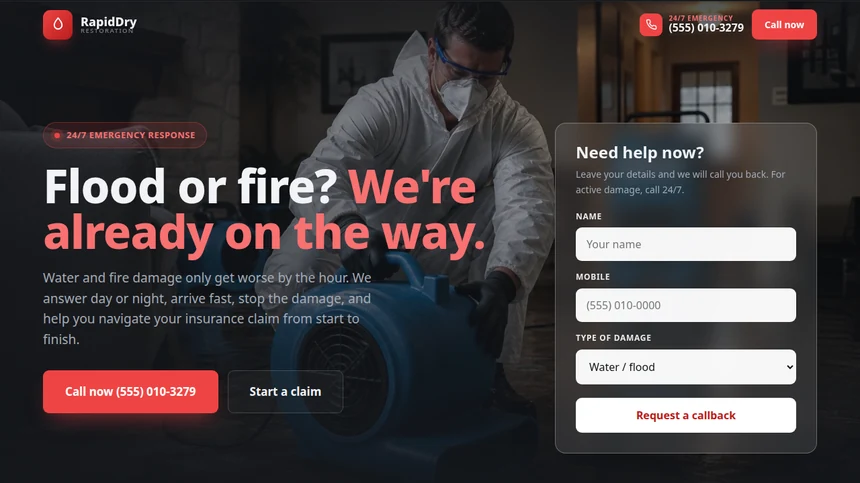
A live property restoration site we built. Open the full example →
What restoration customers decide before they call
Restoration is the most time-compressed decision in home services. Someone is standing in an inch of water, or looking at smoke damage, or has just been told there is mould behind the drywall. They are frightened, often dealing with an insurer, and they will call whoever answers and sounds capable. Almost nobody comparison-shops restoration. That means the site is not persuading over weeks, it is proving in about fifteen seconds that you answer around the clock, you work with insurance, and you can be there soon. Everything else on the page is secondary to those three facts.
What a restoration website has to prove
Certifications carry unusual weight here because insurers and adjusters recognise them, so industry credentials belong high on the page rather than in a footer. State your response time as a specific commitment. Be explicit about working directly with insurance carriers and whether you bill them directly, because that removes the customer's largest practical worry. Photographs of equipment on site, containment barriers and finished restorations demonstrate capability. Twenty-four-hour availability must be real and answered by a person, because this is the trade where an unanswered emergency line does the most damage to a reputation.
Turning restoration website visits into booked work
The phone is the primary conversion path and everything on the page should funnel toward it. The number is fixed, large and tappable on mobile, with round-the-clock availability stated beside it. The form exists for the smaller share of non-urgent enquiries and asks only the essentials: address, type of damage, whether it is active right now, and whether a claim has been filed. Photograph upload helps your crew arrive with the right equipment. Anything longer than that is asking a person in crisis to do paperwork, and they will simply call someone else.
What we build into every restoration website
Your restoration site leads with a permanent, prominent emergency number and a plainly stated response commitment. Damage types are separated into water, fire and smoke, mould and storm, each with its own guidance page, because the immediate advice differs and so does the search. Insurance content explains your role in a claim in plain language. Certifications and equipment are shown rather than listed. The enquiry form is deliberately short with photograph upload. Every submission alerts your on-call team by text immediately, because a queued restoration lead is a lost one.
Where restoration websites usually go wrong
The fatal error is an emergency number that is not visible without scrolling, or an after-hours line that reaches voicemail. Nearly as bad is a long qualification form placed in front of someone with active water damage. Many restoration sites bury insurance information deep in the site when it is the second question every customer has. Generic disaster stock photography is instantly recognisable and undercuts credibility, whereas photographs of your own equipment and crews build it. And treating water, fire and mould as one undifferentiated services page misses the fact that each is a distinct, urgent search.
restoration website design for the Tampa Bay area
Tampa Bay restoration demand is dominated by water: summer storms, hurricane season, and the flooding that follows. Coastal properties in Pinellas face surge and wind-driven rain that inland Polk properties do not. High year-round humidity makes mould a persistent concern rather than a seasonal one, and it changes the drying timelines customers should expect. Storm events create sudden capacity crunches where response time becomes the only differentiator. Naming the counties and communities you cover matters, because someone with active water damage will not wait to discover whether you drive that far.
Want a restoration site like this?
We design, build and host it, and you approve it before it goes live. $97/month, setup waived.
Start my $1 trial →Property restoration website design questions
How prominent should the emergency number be?
It should be the most visible element on the page, fixed on mobile, and never require scrolling. In restoration, response speed is the product, and the phone number is how customers buy it.
Should the site explain insurance claims?
Yes. It is the second question after how fast you can arrive. Explaining your role in the claim, what you document, and whether you bill the carrier directly removes the customer's biggest practical worry.
Do I need separate pages for water, fire and mould?
Yes. They are separate searches with different urgency and different first-hour advice. A combined services page ranks poorly for all three and helps none of the customers.
Is twenty-four-hour availability worth advertising?
Only if a person answers. This is the trade where an unanswered emergency line does lasting reputational damage, and customers talk about it in reviews.
Can customers send photographs of the damage?
Yes, and it is genuinely useful. Photographs let your crew arrive with the right drying or containment equipment rather than making a second trip.
How fast does my team learn about an enquiry?
Immediately. Web submissions trigger a text to your on-call team the moment they arrive, because a restoration lead that waits for someone to check email is already lost.
Try everything for $1
The full CRM, the website, AI follow-up in English or Spanish, and your Meta ads tracked. 7 days for $1, then $97/month. No setup fee, no contract. Or talk to a person first.
Start my $1 trial →